
Research & scientific applications
Hydrophones built for rigorous fieldwork.
Calibrated, broadband underwater acoustic performance for marine mammal research, passive acoustic monitoring, bioacoustics, and environmental assessment. Designed and built in Nelson Bay, used in research worldwide.
Choose your model
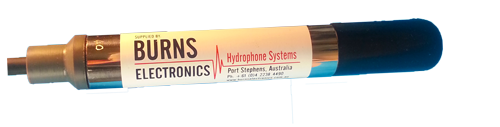
AquaEar CR30-40
7 Hz – 30 kHz
Covers the full audio range for cetacean research: low-frequency baleen whale vocalisations, dolphin whistles, and echolocation clicks to 30 kHz. The standard choice for most marine mammal monitoring.
| Sensitivity | –165 dB re 1V/µPa |
| Output impedance | 150 Ω |
| Depth rating | 100 m |
| Cable options | 5 m / 10 m / 15 m |
| Connector | 3.5 mm TRS |
| Calibration data | On request |
From $700
View full specs & buy
 Ultrasonic range
AquaEar CR80-40
7 Hz – 80 kHz
Extends into ultrasonic frequencies for full-bandwidth echolocation capture — odontocete click trains and porpoise vocalisations. Requires a recorder supporting 192 kHz.
| Sensitivity | –165 dB re 1V/µPa |
| Output impedance | 150 Ω |
| Depth rating | 100 m |
| Cable options | 5 m / 10 m / 15 m |
| Connector | 3.5 mm TRS |
| Calibration data | On request |
From $1,500
View full specs & buy
Individual sensitivity curves are available on request — contact us with your order number after purchase. Custom cable lengths, connector types and multi-channel configurations are quoted as a commercial build.
Compatible recording interfaces
The AquaEar outputs a standard analog signal (3.5 mm TRS, line level with the HP-A1 amplifier), compatible with any interface accepting a line or mic-level input.
Wildlife AcousticsSong Meter SM4, SM Mini
ZoomH5, H6, F-series recorders
Sound DevicesMixPre series
National InstrumentsDAQ systems (with preamp)
iZotope / RMEField recorders & interfaces
Custom DAQAny analog line/mic input
Unsure about your existing setup? Tell us what you're running and we'll advise on gain staging and connectors.
Recommended accessories
The HP-A1 Conditioning Amplifier ($399) is recommended for most research deployments. It provides 40 dB of gain, high-pass filtering to reduce low-frequency flow noise and vessel interference, and balanced output for long cable runs — particularly important with high-impedance or consumer-grade inputs.
The Battery Box ($150) provides self-contained power for remote deployments away from shore power.
Frequently asked questions
Can I get a calibration certificate?
Individual calibration data — sensitivity vs. frequency curves — is available on request. Contact us after purchase with your order details.
What is the self-noise level?
Contact us for the current specification sheet. Noise floor figures vary slightly by production batch and we prefer to give you accurate data rather than nominal figures.
Can cable length be customised?
Yes. Custom lengths, jacketing and connector types are available as a custom build — see our commercial solutions page.
Is it suitable for freshwater deployment?
Yes. The hydrophone is sealed and rated for both salt and fresh water to 100 m.
What sampling rate captures the full 80 kHz range?
A minimum of 192 kHz — Nyquist requires twice the maximum frequency. Most professional DAQ systems and high-end audio interfaces support this. Standard 96 kHz interfaces capture to approximately 45 kHz.
Need something beyond off-the-shelf? Custom cable lengths, multi-channel arrays and DAQ integration are available as a commercial build. Tell us about your project.
Get in touch →